Barahona is located in the southwest of the Dominican
Republic. Before the discovery of America, Hispaniola (now Haiti and the
Dominican Republic) was divided into five chiefdoms, one of
which, Jaragua, Boechío is governed by the territorial boundaries where
the province of Barahona.
Barahona is located in the southwest of the Dominican
Republic. Before the discovery of America, Hispaniola (now Haiti and the
Dominican Republic) was divided into five chiefdoms, one of
which, Jaragua, Boechío is governed by the territorial boundaries where
the province of Barahona.
The province was the scene in 1496 of the first revolution of the social demands
of the New World, the rebellion of Roldan, in which the slaves, the Spanish
and the Indians have challenged the supremacy of the Spanish crown.
The city of Barahona is located along the Caribbean Sea, to
204 km from Santo
Domingo. It has lush vegetation and geographical conditions that combine
rivers, beaches and mountains. Most of its coastal areas are still virgin and
surrounded by mountains with many rivers.
Much of the province, in the western part is occupied by the Sierra de Bahoruco.
There is also the Sierra Martin Garcia bordering Azua, the eastern end of Neiba
Sierra and Loma de Sal y Yezo.
The main river is the Yaque del Sur, which flows a few kilometers north of the
city. The second major river in the province is the Nizaito. Other rivers are
Palomino, Bahoruco, San Rafael, Sito and Los Patos.
Barahona's economy depends mainly on mining and tourism, with an industrial
port and free zone dedicated to mining. The main agricultural products are bananas
and coffee, and mineral products, the larimar and the marble.
This province has many tourist attractions. Beaches, along
with rivers, attract many people. Of these, we cite Saladilla, San Rafael, los
Patos and Quemaítos. Other attractions are the Lagunas de Moncion and
Cabral and the magnetic pole.
The city is also known as the Pearl of the South.
Barahona, because of its distance from major tourist centers of the Dominican
Republic, is a region untouched by mass tourism.
To see, to do in Barahona
Central Park
Casa de los 7 Candados
The house of 7 locks is one of the oldest houses in Barahona,
it dates from 1903, this house is considered by people as a historical relic,
it would have hosted important figures in the history of the Dominican Republic.
To see, to do near Barahona
Lake Enriquillo
Enriquillo Lake is the largest salt lake in the Caribbean and is probably one
of the most impressive natural attractions tourist in the region of Barahona.
It is located about 35 m below sea level and its waters have a salt concentration
three times higher than the Caribbean Sea. Rainfall is scarce and there are
only cactus (some of which are endemic) and some plants grow. In and around
the lake are iguanas, american crocodiles that can reach 2 m, flamingos and
tropical birds. In the center of Lake Enriquillo there are three small islands:
Barbarita, Islita and Cabritos.
Ecotourism
The parks
of the region (Park Jaragua, Park Sierra de Bahoruco, Park Isla Cabrito) to
observe a unique biodiversity in the Caribbean.
The magnetic pole
Going to Bahoruco amazing optical phenomenon.
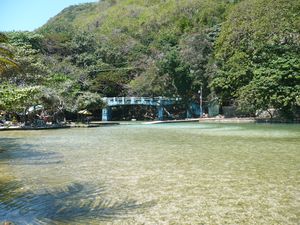
The beach of San Rafael
The beach of San Rafael is located about twenty kilometers south of Barahona,
is a gallet beach surrounded by steep hills with a pool of natural fresh water.
The beach Quemaito
The beach El Quemaito is a popular beach located 10 km from Barahona.
Bahoruco Beach
Bahoruco beach is famous for its surf spot, a rare spot of the Caribbean coast
of the Dominican Republic.
Caves de los Patos
Los Patos caves are located at the mouth of the river Los Patos, inside the
caves, carved in stone are the faces of Indian hand-carved by the ancient Taino
Indians, the original inhabitants of the Dominican Republic.
The lagoon Oviedo
Oviedo Lagoon is a biosphere reserve (it is part of the Jaragua National Park),
composed of over 40 small islands, this is the place to view wildlife and flora.
Laguna Oviedo is one of nature reserves in the Dominican Republic with a wide
variety of aquatic and terrestrial species. Laguna de Oviedo is located south
of Barahona, in the province of Pedernales. This is a major tourist
attraction which attracts many visitors Dominicans and foreigners.
Beata Island
The Beata Island is an island in the Caribbean Sea, it is 27 km2 and is uninhabited.
There are lambi, sea turtles, crabs and lobsters. In 2001 he discovered a
species that is endemic to the reserve of Jaragua National Park, one of the
smallest reptiles in the world of 16 mm.
Villa Miriam
Villa Miriam is a waterfall with cold and clear water, Miriam Villa is located
in San Rafael a few kilometers from Barahona.
Lagoon Cabral
Lagoon Cabral or Rincon is located between the provinces of Barahona and Independencia,
is a wetland of 65 km2 with significant concentrations of birds, mammals, reptiles,
amphibians, fish and invertebrates.
Useful links on Barahona, Enriquillo...